Wednesday, 19 March 2014

Looking to Christ: The Purpose of the Bible Wednesday March 19th, 2014

The purpose of the Bible - looking to Christ

Are you a fan of Victor Hugo’s story Les Miserables? - I am!! I love the book, I love the musical, I love the movie! Today's lesson brought me to think of my favorite scene.

The lesson began with the first question asking us, "what is the underlying theme of the Bible?" Wow, big question! Yet, simple answer: Jesus Christ.
The Bible is complicated, overwhelming, and massive….yet at the most basic level, it’s about Christ - how God loved us so much that he sent his son to redeem us, even though we are unworthy.

Now, back to Les Miserables….my favorite scene is this:  After stealing a loaf of bread to help feed his sister’s starving family, Jean Valjean (hereafter referred to as JVJ) was sentenced to 5 years hard labor.  He served his sentence and extra time for trying to escape - 19yrs total, when he was freed in 1814.  Jean had almost nothing when he left prison, was bitter and hard (hearted).  Finally one night, with no where to go, he sought shelter in a church.  The priest offered him reprieve - a meal and a bed.  But JVJ woke in the night, and couldn’t help himself from stealing the Priest’s silver, which would fetch a nice price when he sold them.  He takes the silver and flees.  Some time later, he is caught.  The gendarmes drag him like an animal back to the church, summon the priest, who will then take his silver back and thus send JVJ back into the prison system - certainly for life now.  However, in a shocking change of events, the priest exclaims, “Ah! Here you are.  I am glad to see you!  But what is this?  I had given you also the candlesticks, and you forgot them.”  JVJ is speechless.  The gendarmes stare in disbelief: “but monseigneur, he was running away, with this silver”...The priest says, “that is your mistake”. They leave, and there is JVJ with the priest.  “My friend, the priest says, before you go, take the candlesticks…(JVJ trembles and remains speechless) my friend. you no longer belong to evil, but to good.  it is your soul that i buy from you, I withdraw it from black thoughts and the spirit of perdition, and i give it to God.”  That moment of pardon is my absolute favorite scene.  It awes me.  From this point onwards, in this epic novel, we see JVJ as he struggles to live a life worthy of this gift, a life under the grace of a forgiving, loving God....demonstrated in the actions of the priest.

Can you imagine?  Someone who steals from you….and when they are brought to you for punishment/confirmation...you offer them more?  it seems beyond human nature.  That is because it is - that kind of grace is from God - and the priest tells JVJ just that - that he has bought his soul for good - and is giving it to God.

Just like JVJ, we do not deserve God’s grace.  We try to live right, but we are human.  God sent His son to us on a rescue mission.  The Israelites had become so regulated and outwardly religious that there was little love in their hearts and actions.  Sacrifice - the very word can be beautiful and ugly at the same time - giving something up, sacrificing something means a loss, yet the purpose is for good, to atone, to heal something.  So it was with the Israelites, they needed to continually atone for their sins, again and again and again.  They were so focused on the laws, that they had forgotten grace.  Interestingly, Les Miserables is a story of just that - the law vs. grace & redemption.  
Just when the Israelites are at their best with outwardly religion and rule following….
there is a rescue mission.

John 3:16 says…For God so loved the world that he gave his one and only Son, that whoever believes in him shall not perish but have eternal life.

GOD SO LOVED THE WORLD: it doesn’t start with us loving him. HE loved us first.  This is not the love I have for my husband, this is not the love I have for my children, the love I have for my friends, for my parents, anyone…
This is a supernatural, surpasses all understanding love.  It is a love of the world and ALL of us in it.  A love for the human race - all of us - me, you, our friends, families, our enemies, in means leaders of every country - good and bad, it means everyone - deserving or not.

LOVE IS GOD.  GOD IS LOVE. 
God loved us first:
sample of what we’ll be getting into with our next study booklet!!
1 John 4: 7-12…
Dear friends, let us love one another, for love comes from God. Everyone who loves has been born of God and knows God. Whoever does not love does not know God, because God is love. This is how God showed his love among us: He sent his one and only Son into the world that we might live through him. This is love: not that we loved God, but that he loved us and sent his Son as an atoning sacrifice for our sins. Dear friends, since God so loved us,we also ought to love one another. No one has ever seen God; but if we love one another, God lives in us and his love is made complete in us.

This week’s lesson is essentially showing us the basic premise that this book is ultimately a book about Christ - from beginning to end.   

Last week we looked at prophecy, and the number of prophecies fulfilled in Jesus is over 300, therefore we KNOW it was not coincidence.  He was not just some guy.  He was not one of many.  He was Gods one and only begotten son.  God became flesh in Jesus, to be with us, to live and walk among us, to feel our pain, to feel our suffering, and our joy and our challenges.  

When I first became a Christian, I rarely looked into scriptures of the Old Testament.  It seemed bizarre.  But after studying some of it (mostly Moses) in a Bible study similar to ours, my eyes opened to see Christ everywhere.  In the book of Matthew, twelve times you will find the term “fulfilled” along with a connection to the Old Testament (that it might be fulfilled, was fulfilled, etc”)

The blood system of sacrifice was finished with Jesus - He was the lamb of God.  Sacrifice and substitutionary atonement were the foundation of the Old Testament and the people’s relationship with God.  God is holy, we are not - we must approach him through or with something that shows our respect and due honor to him.  
2 Corinthians 5:21
God made him who had no sin to be sin for us, so that in him we might become the righteousness of God.

I admit I still don’t understand some aspects of the Old Testament but I take encouragement in that the New Testament is here to explain how Jesus came to complete the Old Testament scriptures - Question 5 in our study “Jesus interpreted to them in all the scriptures the things concerning himself.”

John 3:16 - God loves everyone - WHOEVER - for everyone, unlimited….

God knows everything about me, scary.  He sees how unloveable I am.  He sees my selfish thoughts.  He sees me in the morning when I go to facebook instead of my faithbook.  And he loves me all the same.  He sees me seek happiness when I should be seeking holiness.  And he loves me all the same. He sees me when I suffer - and I go off to send a text instead of remembering I am blessed.  And he loves me all the same.

And for me, in this ugliness, he sacrificed his very own one and only son?

Just like the priest rendered JVJ completely dumbfounded by his grace and forgiveness, above and beyond that generosity; God has pardoned our sin, all of our faults and yuck, and given us his son, to not just give us a new life, but an abundant life:

John 10:10

“I came so that all might have life; and have it to the full”

Wednesday, 12 March 2014

Wednesday March 12th, 2014 "Amazing Predictions!"

Study 9 & 10
A book of amazing predictions

Our group visit to the British Museum!

From a very young age, we want to know what is going to happen next.  A child will get very upset if someone stops in the middle reading a story! We have a hard time turning off the TV, putting down a good book, etc. We want to know the rest of the story.  
We want to know what happens next!!
We all want to know how things are going to turn out.

Guess what.  The disciples were no different.
Matthew 24:3 
As Jesus was sitting on the Mount of Olives, the disciples came to him privately.  "Tell us," they said, "when will this happen, and what will be the sign of your coming and of the end of the age?"
Most of Chapter 24 of Matthew is his answer.

Why do we have prophecy?
1Corinthians 14:3 "Those who prophesy speak to people for their strengthening, encouragement and comfort."
For good - to help us, to guide us.  

IT IS OKAY FOR CHRISTIANS TO HAVE DIFFERING CONVICTIONS ABOUT PROPHECY.  Do you think God wants to see his children bicker and fight over when and how the world is going to end? None of us has enough information to know all the details about what is going to happen in the future.  We have only that which is in the Bible, and that may convey a different meaning to different people - we must approach prophecy discussions with a spirit of peace and love.

WHAT IS PROPHECY?
Prophecy means speaking on behalf of God, delivering His message or words. There are prophets in the Old and the New Testament. Some prophecy delivers the will of God for his people - teaching, directing, warning.  A second kind of prophecy predicts the future - this is usually what we think of when we think of prophecy (who doesn’t want to know the future, right?).
We study prophecy not only to learn about the future, but to understand our daily lives - we have an advantage over those who do not know their Bibles - we can rest in the certainty of Christ's victorious ending - “that every knew shall bow” (Phil 2:10, Roman 14:11) - giving us strength, steadiness, and confidence in the midst of our day to day anxieties, stress, or hard circumstances.

WHY IS BIBLICAL PROPHECY IMPORTANT?
-prophecy encourages Godly living
1 John 3:2-3  
"Dear friends, now we are children of God, and what we will be has not yet been made known.  But we know that when Christ appears, we shall be like him, for we shall see him as he is. All who have this hope in him purify themselves, just as he is pure."
Knowing the future stirs us to holy living in preparation of meeting to the One who is pure. PURE - I love the Bible verses about purity - there seems to be so little of it in this world today.

-prophecy gives us hope
Revelation 21:4
"He will wipe every tear from their eyes. There will be no more death or mourning or crying or pain, for he old order of things has passed away"
When we see suffering, tragedy, sin around us - let us cling to this verse and the truth and hope in it!
We live in a complicated world, with pressures and international conflicts.  
But we know that God is in control.

--We should not attempt to guess at the date of the end times.
Matthew 24:36
“But about that day or hour no one knows, not even the angels in heaven, nor the Son,but only the Father."
Many people feel they see “signs” of the end times.  I have an aunt who is I'm sure well meaning but constantly sending emails about warnings of the end times...
It gets to be a turn off.  
Instead of trying to calculate such things and obsess over the aspects of our world that are clear signs of the end times, we should be alert and ready, ready in our hearts, and motivated to help as many people as possible to come to know Christ Jesus (through our actions and love).

Here are some visuals with great examples of prophecy from the Bible


Now with all this accurate prophecy, we would think that people would just GET IT.  The Bible is God's true word to us.  EASY.
But no.
We are stubborn aren't we?!

We're going to look at 3 things that critics say, so you can be prepared with a response when talking to others.

First, people say, it is pure coincidence.
COINCIDENCE = GOD'S WORK
Guess what, it cannot possibly be coincidence.  
How many prophecies did we say Jesus fulfilled?  Yes over 300.  
Here are a few of them.


Mathematicians will assure you, this CANNOT be coincidence!

Secondly, some people are going to say that because the Bible was written by men, that once we knew about Jesus's life, they were smart enough to go back to the Old Testament and change all the verses about him so that it all matched up.  Yes, they took all the events of Jesus's life and then went back and edited the OT so that it all makes sense.
Why is that wrong???  
What do we know from our last few lessons?  
From about 433 BC, the OT was complete and DID NOT CHANGE after that - we know this because of all the archeological evidence - manuscripts, scrolls, etc that have been unearthed - and low and behold it is the same text we have today!

Finally, some will argue that because they had the Old Testament, and we know Jesus knew it all right - that he then made sure that he was checking all the boxes to be "The Messiah".  He made it all happen for himself.  Hmmmm.....how many of us choose the place of our birth and death?  Do you think he could control the Roman guards?  There are just frankly too many "coincidences" (again) for this to be orchestrated.  Impossible!

So what does all this prophecy stuff mean for us.  
We learned from this week’s lesson  - the fact that the Bible is 30% prophecy and so far the accuracy is spot on, we have trust in this book - as the Word of God.  It is a supernatural book.  Being able to predict the future can only come from Him who knows the future - from our supernatural God - our Alpha and Omega.  
Prophecy gives us warnings and encouragement - God will make everything right - justice may seem deferred but it will never be denied.  God is already working to fulfill his purposes through Jesus - through Christ he entered the suffering of the world, bore the world’s sin, and fights against evil.  He will continue to show us His faithfulness!
God does not want us to worry about the future or try to predict it ourselves....

George MacDonald said:
No man ever sank under the burden of the day.  It is when tomorrow’s burden is added to the burden of today that the weight is more than a man can bear.  Never load yourself so!  If you find yourself so loaded, at least remember this: it is your own doing, not God’s.  He begs you to leave the future to him, and to mind the present.


Monday, 10 March 2014

Field Trip to the British Museum Wednesday March 5, 2014

Wednesday March 5th, 2014

Class field trip to the British Museum

Our study booklet, "God's Amazing Book" asks us to examine the history of the Bible, the validity of the Bible and the formation of the Bible - among other scripture searches.

One of our servant team members has been to Israel several times.  Each time she tours, she says she is surprised at the number of times the guide declares, "well we would see this, but it is now housed in the British Museum".  How lucky are we, in London, thus very capable of going on any given day to see these artifacts!  However, as we know, artifacts that are important for Christians and the historicity of the Bible often don't have large signs nearby stating "Come and See!!  This is an important artifact for Christians!"  We had heard of Christian tour guides who help direct groups to find the important Christian items, and decided it would be a great class outing to do just such a tour ourselves.

Our guide, Fiona Cater, took us on a one-hour and forty-five minute journey to see some of the great items relating to the Bible.

Here are a few examples from our tour:

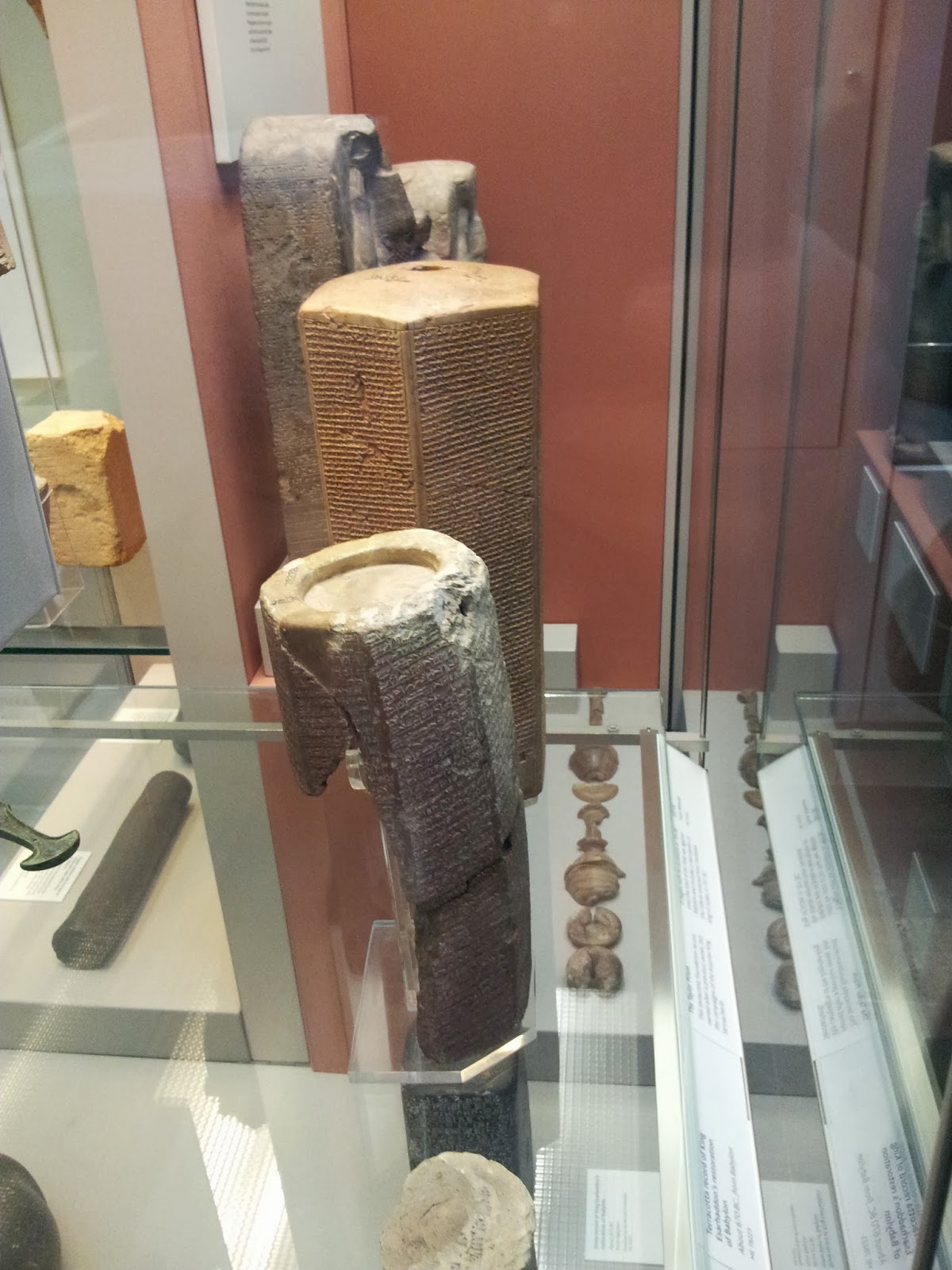
Room #55 - Assyrian prism
"They said there was no such king as Hezekiah"
Then they discovered:
Sennacherib's Prism Reveals King Hezekiah
This six-sided hexagonal clay prism, commonly known as the Taylor Prism, was discovered among the ruins of Nineveh, the ancient capital of the Assyrian Empire.  It contains the Annals of Sennacherib himself, the Assyrian king who had besieged Jerusalem in 701 BC during the reign of king Hezekiah. On the prism Sennacherib boasts that he shut up "Hezekiah the Judahite" within Jerusalem his own royal city "like a caged bird." This prism is among the three accounts discovered so far which have been left by the Assyrian monarch of his campaign against Israel and Judah.


Room 55 - From the time of Daniel 
Critics of the Bible questioned the book of Daniel because of the predictions made in the text.  
The panel shows a pacing, roaring lion and once was part of King Nebuchadnezzar II’s throne room in his palace in the ancient city of Babylon, Iraq. Nebuchadnezzar II reigned from 605-562 BC, and supposedly had the hanging gardens of Babylon built for his queen. Although there is little evidence to confirm his passion for gardening, it is certain that Nebuchadnezzar commissioned other major building projects in Babylon, to glorify the capital of his empire. Inscriptions stamped on bricks reveal the extent of these works. In the city of Babylon, glazed bricks in bright shades of blue, yellow and white were used to create public monuments that emphasised the power of the king and the gods. In Nebuchadnezzar’s throne room the roaring lions emphasized the power and might of the Babylonian king, whose empire stretched from the Persian Gulf to the Mediterranean and from the Caucasus to northern Arabia.

Room 52 - glazed tile from the Persian Empire 
Queen Esther would have walked by such a panel in the palace, and jewelry in this room would also represent the style and kind of jewels and adornments she would have worn

Achaemenid Persian, late 6th century BC

From Susa, south-west Iran   

From the palace of Darius I, ruler of the largest empire in antiquity

This panel is made of polychrome glazed bricks which were found by French excavators scattered in a courtyard of the palace built by the Persian king Darius I (522-486 BC). At least 18 figures have been restored. It was part of a larger frieze depicting rows of guards, perhaps the 'immortals' who made up the king's personal bodyguard. The arrangement of the figures may have been similar to the rows of sculptured guards carved in relief at Persepolis. According to a foundation inscription at Susa, the craftsmen who made the brick panels came from Babylonia where there had been a tradition of this sort of architectural decoration.
Linked to the city of Sardis in western Anatolia by a 'royal road', Susa was the most important administrative centre of the Achaemenid Persian empire and the court probably spent at least part of each year there. Darius undertook much building at the site. Amongst his most impressive projects was the Apadana or audience hall and an adjoining palace where this panel was discovered.


Room 49 - the first image of Jesus in Britain
One of the last items of our tour was this wonderful image of Christ from a Roman tiled floor.  Uncovered by a resident of Dorset digging in his garden in the 1960's, this is believed to date to 360AD and would be the earliest known image of Christ in the UK.  Fiona said it could have been used as a way to tell others about Christ - perhaps, yes, the first evangelists in Britain!

Ready to take a tour yourself?
Fiona's information:
http://christianitytours.com/index.html

Sunday, 2 March 2014

Wednesday February 26th 2014

The Formation of the Bible
BIBLICAL CANON

NEXT WEEK WE ARE GOING ON A FIELD TRIP TO THE BRITISH MUSEUM!  WE WILL HAVE A BLUE BADGE GUIDE GIVE US INFORMATION ON THE BIBLICAL ARTIFACTS IN THE COLLECTIONS!

Study 8 "God's Amazing Book"
This week we asked the question, "how did we get these books that make up the Bible?"
We all know the Bible didn't fall out of heaven.  We also know that there are some books that have some controversy attached to them - some think they don't belong in the Bible; and other books that are not in the Bible and some people think they should be in the Bible.

Recent years have opened a floodgate of questions about the books of the Bible.  But we can rest assured that our Bibles are just what God intended.

What is the biblical canon?
CANON = the term comes from Greek originally meaning measuring rod, a ruler, the books meet the standard.  From about 170 AD, the church leaders spoke about the Canon of Christian teaching, the canon of truth.

Let’s start with the OT.  The Torah was given to Moses by God.  The other stories, written by divinely inspired kings and prophets, were added soon after they were created, and authorized by the Jews.   About 5 books were disputed for a while - Song of Solomon (human love story?), Ecclesiastes (too negative?), Esther (no mention of God?), Ezekiel (some believe it contradicts the Law of Moses).  Yet most Jewish scholars came to accept these books as scripture.  To their credit, they were cautious enough to raise the questions and do proper examination.

We have 39 Old Testament books in the English Bible.  But the original Scriptures only had 24.  This is because some material was broken up into smaller pieces.  Samuel, Kings and Chronicles were originally one book/manuscript - but it was too long to fit onto a single scroll.  Ezra and Nehemiah were also one book, as was the Minor Prophets.  

After 430 BC and until about 26 AD, nothing more was added to the OT - it was complete.  That began a period called the "intertestament period", a period of silence.

There was a council in 90AD (the council of Jamia) which confirmed the canon - they did not add or subtract any books - just examined and confirmed.

The New Testament!    The OT came to be over centuries. The books of the NT were written all in the last part of the first century, and with an amazing amount of unity, certain texts and books became what we know as authoritative Scripture.  There are 27 books in the NT and of those, 20 have had zero - none - controversy.  There have been disputes, over these 7 books, Hebrews, James, 2 Peter, 2John, 3 John, Jude, Revelation… there was just hesitation on these particular books.
Why do Roman Catholics have a different canon than Protestants?  The last question has to do with the fact that the early Roman Catholic Church followed a well known bishop's influence (Augustine) in accepting the Apocrypha as canonical.  The other early eastern Christians did not.
Hebrews has been questioned because the author is unknown.  Revelation has been questioned for the same reason.  And yet the books were eventually accepted.  Other books, such as the Shepherd of Hermas and the Gospel of Thomas were rejected.  According to scholars this shows just how careful the church was - they proceeded cautiously and with analysis.  According to one Bible scholar Bruce Metzger, The canon is a list of authoritative books more than it is an authoritative list of books.  The documents didn’t derive their authority from being selected, each one was authoritative before it was gathered together with the others.   He goes on to say that to look at the books now would be like getting academies of musician together to make a pronouncement that "the music of Bach and Beethoven is wonderful" - we know these things are true.

The so called “lost gospels” originated long after the canonical Gospels, and were influenced by a sort of mysticism and Christianity.  Our NT writings were all written with living witnesses, the gnostic/lost gospels were written later by Alternative Christianities/heretical groups rising up.

Some argue that the council of Carthage in 397 determined the books.  But they simply confirmed and ratified the books that had already been authoritative and recognized for the previous 2 centuries.

The books have a self-authenticity that is supernatural.  Some of the books became a common part of Christian worship and therefore organically became accepted use.  
The New Testament has not only survived in more manuscripts than any other book from antiquity, but is has survived in a purer form than any other book - a form that is 99.5 percent pure to the original (Case for Christ)

Around 1227, a professor at the University of Paris divided the Bible into our modern chapter divisions.  This arrangement was then followed in later translations of the Bible and became widely accepted by the 1400s.

It was not until the 1500 that verses began to be numbered.

The first Bible to use both the modern chapter divisions and the verse numbers was the Latin Vulgate edition of Robert Stephanus in 1551.

“other writings”
A whole collection of writings was discovered in Upper Egypt, in Nag Hammadi in 1945.  These writings, although interesting and important, are not able to change the four gospels that we already have and do not fit into the text of the Bible as we know it today. They are not parallel works and were written quite some time after the four gospels of the Bible.  They are different - for example - The Gospel of Thomas reads like a collection of sayings.
If you are interested in these other gospels, go ahead and read them, say the experts, and you will see that they are far removed from Jesus ministry and the eye witness quality testimony and harmony of the other gospels.
How and who decided which books were considered authoritative and which were not (Gosple of Philip, Gospel of Truth, Gospel of Mary, etc).
3 criteria:
1books must have apostolic authority: have been written by the apostles themselves, eyewitness to what they wrote about, or a follower of an apostle.  Mark and Luke were not apostles, but Mark helped Peter and Luke with Paul.
2rule of faith: was the document congruent with the basic Christian tradition that the church recognized as normative?
3was the document used continually by the church at large
There was a high degree of unanimity during the first 2 centuries of the NT.
William Barclay said "It is the simple truth to say that the New Testament books became canonical because no one could stop them doing so."

Bruce Shelley "Church History in Plain Language" writes:
“In one sense, of course, Christians created the canon.  Their decisions concerning the books were a part of history.  In another sense, however, they were only recognizing the writings that had made their authority felt in the churches. The shape of the New Testament shows that the early churches' primary aim was to submit fully to the teaching of the apostles.  In that purpose they shaped the character of Christianity for all time.”  

If you are interested in expanding your Bible translations and editions, get a copy of the Chronological Bible - this lists the books in the order that they happen historically - very different from the order of books we have.  Ours follows a pattern used in the ancient Greek translation of the OT. The Septuagint was completed 2c before Jesus's lifetime! The story goes that 72 scholars met to produce a Greek translation of the OT in 72days - Septuagint became the name attached to this immediately approved and accepted writing of the OT.

As a whole, the Bible is fascinating and frustrating at the same time.  The eclectic collection that makes up the 66 books from Genesis to Revelation is inspired by God, the spiritual explained in worldly ways that we sometimes cannot grasp, holiness written by unholy hands, read by our unholy eye and processed by our unholy minds (paraphrasing from Rachel Held Evans).  For many of us, we love the theme of forgiveness and enemy love in Jesus's teachings, but cringe at the acts of genocide in the book of Joshua and some of the teachings regarding women's roles and slavery.  In fact, back in the 1800s, some Christians used Ephesians 6 to support the institution of slavery, while other Christians used Galatians 3 to support abolition. Only one side seems right to us today.  We managed to work our way around these difficulties to develop a shared sense of right and wrong, in community agreement.  It was not easy, but could it be that God wants us to discuss and grapple with these issues because it's about community, making decisions about faith together.  If God gave us all the answers we wouldn't need to rely on him.
Accepting the Bible is not about being right all the time and being able to interpret every scripture with ease.  It's about loving God, understanding the roots and history of the journey of the Christian faith, and above all:  loving other people - enemy love, unconditional forgiveness, generosity.


The History of the Bible...it’s absolutely massive, incomprehensible, and it’s fascinating.  

Wednesday, 12 February 2014

Wednesday February 12th 2014

Class announcements:
NO CLASS NEXT WEEK for half-term.
Next class February 26th.
March 5th we will have a field trip to the British Museum to see amazing Biblical artifacts!


From today's study:
MORE HISTORY OF THE BIBLE!!

Why do we believe this book, the Bible, is actually the word of God?
If someone asks you that question, how would you respond?  Would you be prepared to respond?  For some weeks our lessons are examining the authority of the Bible.  Jill gave great archaeological evidence 2 weeks ago, last week we considered the gospels as eye witness testimony, and this week we are looking at the actual physical manuscripts - the actual book itself and its history.

To look at the Bible's validity requires a fusion of many different disciplines.
History-Literature-Archaeology-Science-Spirituality-Anthropology-Sociology

Even scholars are overwhelmed by all the unique aspects of the Bible.  So, when you feel lost, or just like it's too much, take heart - even the academics struggle to take it all in.  Luckily, they do the work for us - but it is massive - the volumes and volumes about it all...but it is fascinating.  In gathering the information today, I decided to give some broad essentials and then look at some specific examples of manuscripts - perhaps which you can go and have a look at for yourself.

Have you ever considered whether or not we are reading a Bible that represents what the original writers intended/wrote?  How many of you are reading an original copy in Hebrew, Aramaic or Greek?  None of us.
The original scriptures would have been written in Hebrew (the Old Testament in particular) and on papyrus - what we are reading is a copy of a copy of a copy of a copy….etc...how can we trust this version as reliable?

Some vocabulary -
A scroll is a book made of flattened papyrus plant, parchment or animal skins rolled around sticks at both ends.
Papyrus is a tall plant that grows in water, from which paper can be made.  Much of the early biblical material was papyrus.  It was relatively cheap but very fragile and not durable.
Manuscripts - pieces of HAND written text
Codex - manuscript book of an ancient biblical text.  The process was pioneered by Christians to replace the scrolls on which the Scriptures were written, and is considered to be the most important advance in the history of the book prior to the invention of the printing press.

The facts - the facts are that we have a massive, massive amount of manuscripts - they continue to uncover more manuscripts even now. Some 25,000 manuscripts - more than any other ancient text!


Most of the stories would have been orally preserved, originally.  Doesn't that mean that there would have been errors, like in the telephone game? NO!
Not for the Jews - they were commanded by God to Meditate on the law day and night (Joshua 1:8) - most of them would be able to recite the Pentateuch with amazing accuracy.  Just like some kids today could tell you the story of Little Red Riding hood or Jack and the Beanstalk.  If someone told it with error, there would be objections.

The discovery of the Dead Sea scrolls proved that the text had not changed over nearly 1000 years.  These oldest fragments of OT that we have date to 200BC.  The story of the Dead Sea scrolls is fascinating.  In 1946, a young Arab shepherd boy was herding his goats. Two of his goats wandered off into a cave.  He threw a rock into the opening and heard pottery breaking, which led him to discover clay jars with scrolls.  That began the unearthing of a massive amount of manuscript in that area - in caves near the Dead Sea. After finding these manuscripts, scholars were able to prove that the text of the Bible had changed very little over the past thousand years.  Not all the manuscripts or fragments are Biblical - some are community scrolls. So it was an amazing find indeed!
"Cave 4" - had over 15,000 fragments
The Isaiah Scroll was found relatively intact and is 1000 years older than any previously know copy of Isaiah, and is almost exactly as the book reads today.

The New Testament was written by 100AD, and we have many many fragments of ancient texts.
One of which you can go and see.
Right here in London.
The Codex Sinaiticus (most of it anyway) is housed in the British Library.  It dates to about 350AD, and is hand written in Greek on parchment (skins of donkeys or antelopes).  It is the oldest complete Bible in the world.  
This book has been examined so scientifically that they can see where the animals (from whose skin the book pages are formed) were bitten by insects.  

Have any of you been to Ireland?  Or will you be going?  If you do, be sure that you go and see the Book of Kells.
The finest medievial book in the world can be found in Dublin, at Trinity College.  The book of Kells is a masterpiece of Western Calligraphy and is considered Ireland’s finest national treasure.  The book was meticulously written by monks in about 800AD, and following a Viking raid was thrown into a ditch, then recovered minus the gold and jeweled cover, and stored in Kells until it was offered to Trinity college in 1661, where it has been housed ever since.  

So we have all these manuscripts, then the stories are true?  If that is our argument, then does that mean, because there are so many copies of Aesop’s fables, that they then are true?  
No - obviously...the PURPOSE of writing is key in all of this.
Well there is the difference in the purpose of the literature.  Why were the stories written?  For pleasure?  Or to make a record?  This is where we connect to last week’s lesson and the importance of understanding that the New Testament was written as Eye Witness Testimony.  History.  Letters depicting what was happening at a certain point in time.  These were records.  Documents.  

From all these manuscripts, we can be certain that the Bible has changed - but not much - over time.  Of course there are a huge number of translations available - variations even between our Bibles - but the overall meaning and intent is the same.
66 books, written by more than 40 authors inspired by God over the course of 1500 years.  And one consistent theme: God’s love for people and his plan for redemption through Jesus.
And it is very much today what is was almost 2000 years ago.
That is unbelievable.  
TIMELESS TRUTH!!
The History of the Bible...it’s absolutely massive, incomprehensible, and it’s fascinating.  

Wednesday, 5 February 2014

Wednesday February 5th, 2014

Lesson 6 
God's Amazing Book
Is God Really the Author of this Book?

The Witness of Scripture

Eye Witness Testimony - What is it and why is it important when we are talking about the Bible?
When we pick up our Bible, we think of it as a big book.  I think of it as a HUGE book - daunting, sometimes overwhelming, but always, always teaching.  But it is more than that.  We've talked before, in our class, about how it is actually a library.  But that library isn't just one filled with all different kinds of mini-books.  That library actually contains documents, records, and letters.  Many of the documents are what we consider "eye witness testimony" accounts.

So for today's class, we wanted to get everyone thinking about what it means that the Gospels are eye witness accounts.

They tell us what the writers saw, experienced, and witnessed.

In a judicial court, eye witness testimony can be the most powerful aspect of a case.  Calling an eye witness to the stand carries great ramifications for any courtroom trial.

And as we read the Bible, we must consider the Gospels to be just that - eye witness testimony.

This truly can revolutionize the way we understand the Gospel stories.  If you doubt that they represent eye witness testimony, I encourage you to read any of the literature which details the reasons it can be nothing less....

Here are just a few titles to recommend:
Letters to a Skeptic (Boyd)
The Case for Christ (Strobel)
Jesus and the Eyewitnesses (Bauckham)
Mere Christianity (CS Lewis)

The arguments take up volumes and volumes of literature.
Get one of those books and read it for yourself.

But never, ever forget:  when we are reading the Bible, we should imagine reading hand-written letters, by people who lived with Jesus, people whose contemporaries were there when the writings first appeared, as the story first circulated, as the Good News spread.  The writings that changed the world.

We will NOT have class on the 19th of February because of the school calendar half-term break.
For next week: Study 7
See you then!


.


Google+